SEC sends the climate disclosure rule to the ground

The US SEC sent a letter to the appellate court confirming that it will formally initiate the process of repealing the 2024 climate disclosure rules. After months of legal maneuvers, the picture is clear: the rule will not survive.
SEC will use a formal "notice-and-comment rulemaking" – i.e., a full regulatory process with publication of the proposal, public consultation, and the possibility of judicial review of the final rule.
In September 2025, the court dismissed SEC's attempt at a shortcut, in which it argued that the rules "exceed the statutory authority of the commission" and that "costs outweigh benefits".
In the original rule adopted in 3/2024, which was the US counterpart (a lighter version) of the European CSRD, the obligations were:
- disclosure of climate risks and the strategies for managing them
- financial impact of severe meteorological events
- reporting of Scope 1 and 2 emissions for selected companies
Deliberation and possible repeal of the regulation is a relatively lengthy procedure (typically 12–24 months), the public gets a chance to comment, and the final revocation will again be subject to court challenge, so final approval may take years.
What to take away from this?
1. USA vs. EU – the divergence deepens. While the EU this week refined the CSRD/ESRS standards and the Commission launched the Open Coalition on Compliance Carbon Markets together with Brazil and China, the USA are going the opposite direction.
2. The practical impact is smaller than it seems. Large American companies will continue to report climate data, whether due to investors (BlackRock, Vanguard, State Street independently require the data), the EU CSRD (American subsidiaries under CSRD), or national regulations (e.g., a requirement for companies in California with revenues over $1 billion operating in CA), and other voluntary frameworks.
3. For asset managers: Convergence around the ISSB is more important than the SEC rule. Watch who is adopting the ISSB S1/S2 – it is already happening in the UK, Canada, Japan, Australia, Hong Kong. The American fragmentation is primarily a political signal, not a practical end‑game for climate disclosure.
4. For the Czech Republic and Central Europe: No direct impact. On the contrary – if a Czech company with ambitions in the USA wants certainty of compliance, CSRD reporting + an ISSB equivalent is today a more reliable infrastructure than relying on a federal framework that may change several more times.
Related articles
The UK is introducing its own standards for sustainability reporting

ESG reporting - USA cancels, EU simplifies, Australia narrows.
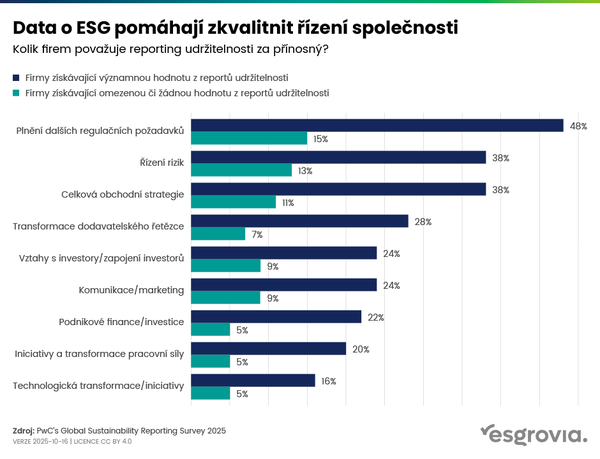
Data on ESG help improve company management