“Honey, we have a problem”
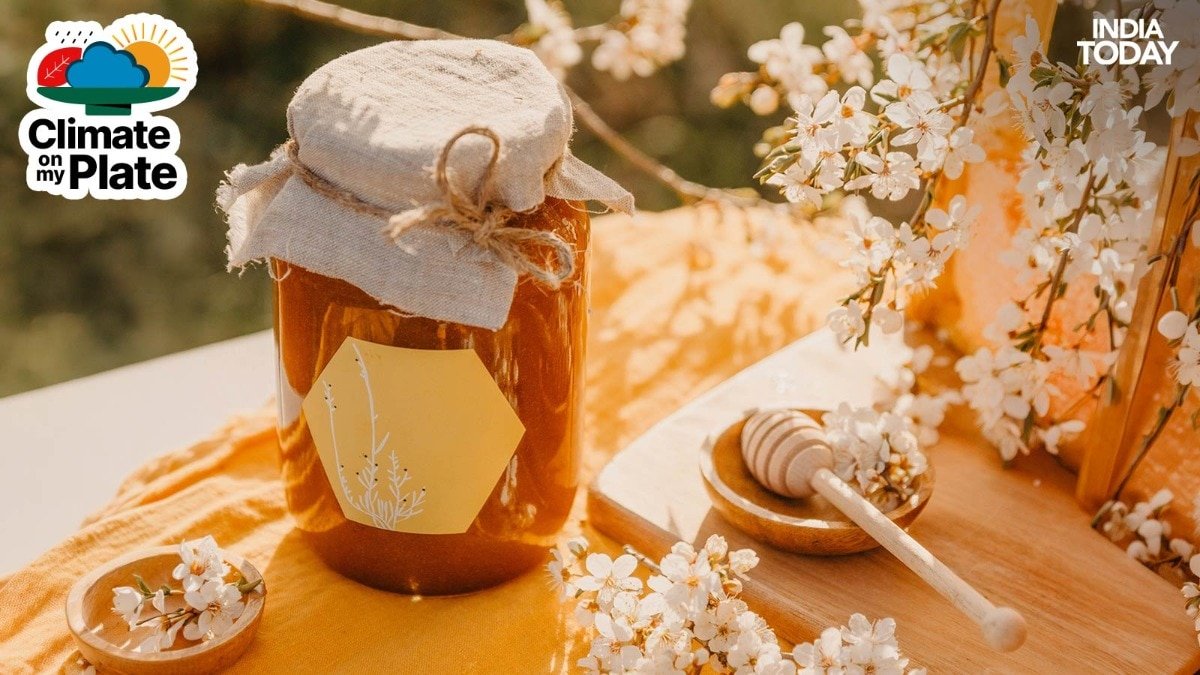
The Indian magazine India Today presents an elegant story that is based on very solid data. Honey in a jar is a chemical archive of every flower that bees visited during the season – and this archive narrows, thins, and becomes chemically poorer.
What happens at the level of an individual flower:
- +6 °C warming + water stress → nectar volume drops by 60 %, pollen weight by 50 % per flower (Frontiers in Plant Science, 2011)
- Extreme temperatures disrupt the microbial environment in nectar → Lactobacillus disappears, heat‑tolerant bacteria take over → taste, scent, and attractiveness to pollinators change (Frontiers in Microbiology, 2022)
- The flower looks the same, but inside it is completely different
What happens at the ecosystem level:
- Individual species shift phenology at a similar pace, but the overall overlap between flowering and pollinator activity at the community level declines (Ecological Monographs, 2025)
- Study of 2 500 honey samples from 310 locations in Europe: warming + drier conditions reduce floral diversity, compensatory maneuvers for bees disappear (Nature Communications, 12/2025)
- PNAS study (9/2025): analysis of 15,000 samples over 120 years shows an increasing risk of secondary local extinction – a flower that loses its pollinators disappears
What is changing in honey:
- Communications Biology compared 441 honey samples (2017) with a nationwide survey from 1952 – the species composition of plants from which bees collected has fundamentally changed.
- Spatio-temporal mismatch: 130 million years of coevolution of flower and bee – and climate change shuffles this "calendar" in a single generation. Some species shift temporally, others spatially, at different rates. A new type of ecological interaction emerges with unknown consequences (Frontiers in Bee Science, 2025).
What to take away?
The system is not collapsing. It is unraveling. Slowly, quietly, one failed flowering season after another. This is a deeper truth about climate in general – setbacks do not come in a single wave, but as a cumulative erosion of functioning relationships that we have downplayed.
Honey in a jar is a climate archive. Just as ice cores reveal the past atmosphere, a jar of honey shows what bloomed in a given season. And this archive is chemically impoverishing right before our eyes.
For business this means three things:
- F&B sector: pollination dependency must be included in TNFD reporting. No pollen, no fruit; no fruit, no juices, jams, muesli.
- Investors: the ECB warned last week that banks are underestimating nature risks. Bees in India are one of the most tangible proofs why.
- For the Czech Republic: rapeseed honey is harvested 2–3 weeks earlier than in the 1990s, acacia honey is becoming increasingly unpredictable. We do not yet have a national pollinator monitoring program – but we should.
The glass on your table is real. The world that made it, however, is quietly deteriorating.
Related articles
Norwegian sovereign fund sets new rules: companies must manage nature-related risks
The number of butterflies on European meadows has decreased by half over thirty years. And from this year it is a legally binding indicator.
Tropical peatland fires have reached a 2000‑year maximum. And humans may be responsible.